
Home » Blogs » Water Quality and Health » How to Check Water TDS at Home? Easy Guide
You can check water TDS at home using a digital TDS meter. Collect a fresh water sample in a clean glass, switch on the meter, place its probe into the water, wait for the reading to stabilize, and note the result in ppm. For example, a reading of 250 ppm means the water has an estimated total dissolved-solids concentration of about 250 mg/L. However, TDS alone does not determine whether water is safe to drink. Other factors, such as hardness, pH, microbiological quality and specific contaminants, may also need to be assessed.
The easiest way to check water TDS at home is with a digital TDS meter. The process usually takes less than a minute.
Follow these five simple steps:
For example, if your meter shows 280 ppm, your water has an estimated TDS of approximately 280 mg/L.
If you test the same tap a week later and get 520 ppm, the difference indicates that the dissolved-solids level has changed. This does not automatically mean that the second sample is unsafe; it simply tells you that the water characteristics have changed and may warrant further investigation.
This distinction is important because TDS is only one aspect of water quality.
TDS stands for Total Dissolved Solids. It refers to dissolved substances present in water, including minerals and salts such as calcium, magnesium, sodium and potassium.
TDS is commonly expressed in parts per million (ppm) or milligrams per litre (mg/L).
A simple example can make this easier to understand.
Suppose you test three water sources:
Water Source | Example TDS Reading |
Municipal tap water | 220 ppm |
Borewell water | 650 ppm |
Another household water source | 1,000 ppm |
These readings show that the concentration of dissolved substances varies between the samples.
However, a TDS meter does not tell you exactly which substances are responsible for the reading. Two samples with similar TDS values can have different compositions.
Therefore, TDS should be treated as an indicator, rather than a complete water-quality diagnosis.
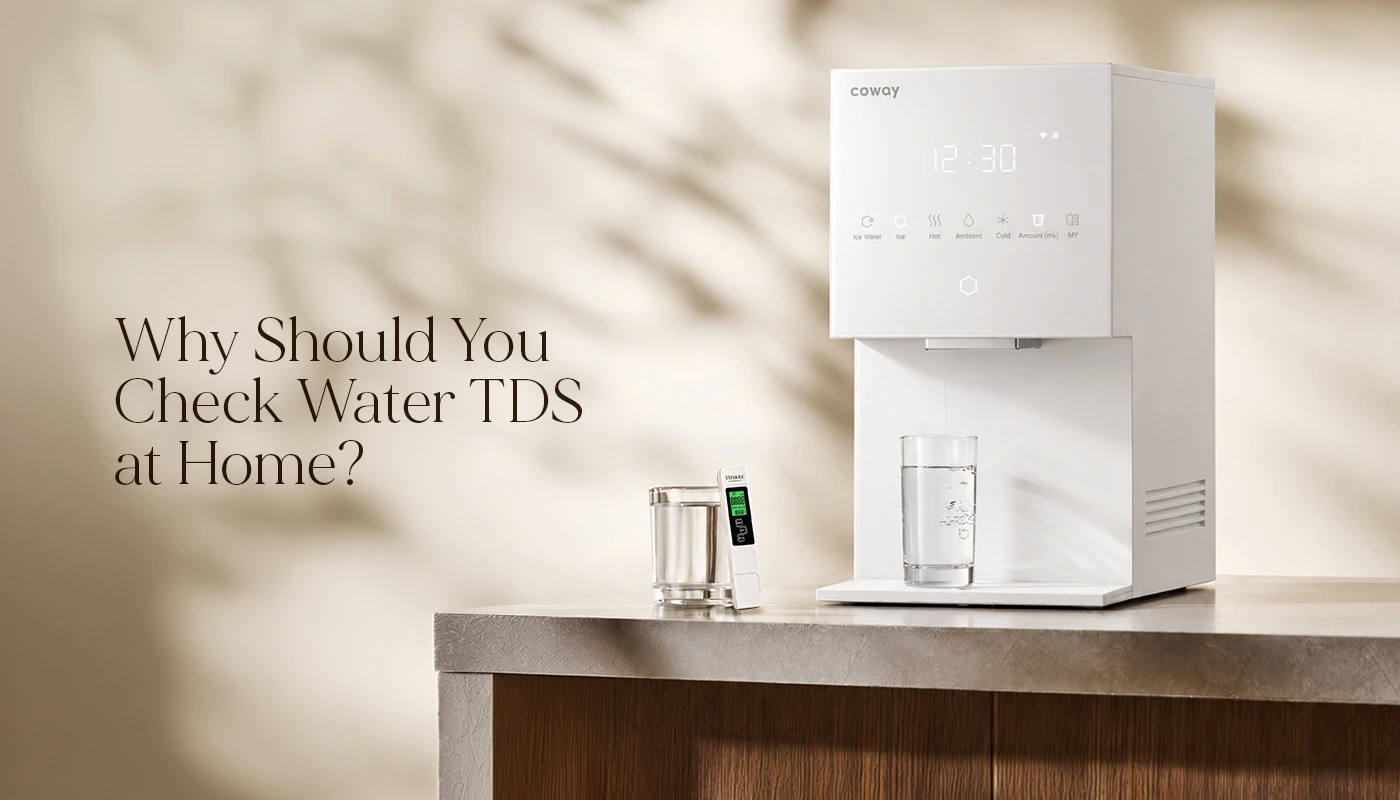
Checking TDS can help you understand changes in your household water.
This can be particularly useful when your home receives water from different sources, such as:
You do not need complicated laboratory equipment for a basic TDS reading.
You generally need:
Digital TDS meters are small and easy to carry, making them convenient for household checks.
Before testing, always follow the instructions provided with your particular meter because operating procedures and calibration requirements can vary between devices.
Consider an apartment where the usual municipal water measures 240 ppm.
During a period when the building uses tanker water, the reading increases to 720 ppm.
That significant change is useful information. It suggests that the water source or its characteristics have changed. You can then consider whether additional water-quality testing is appropriate.
For households in apartments, especially where water sources can change seasonally or according to availability, periodic checks can provide useful context.
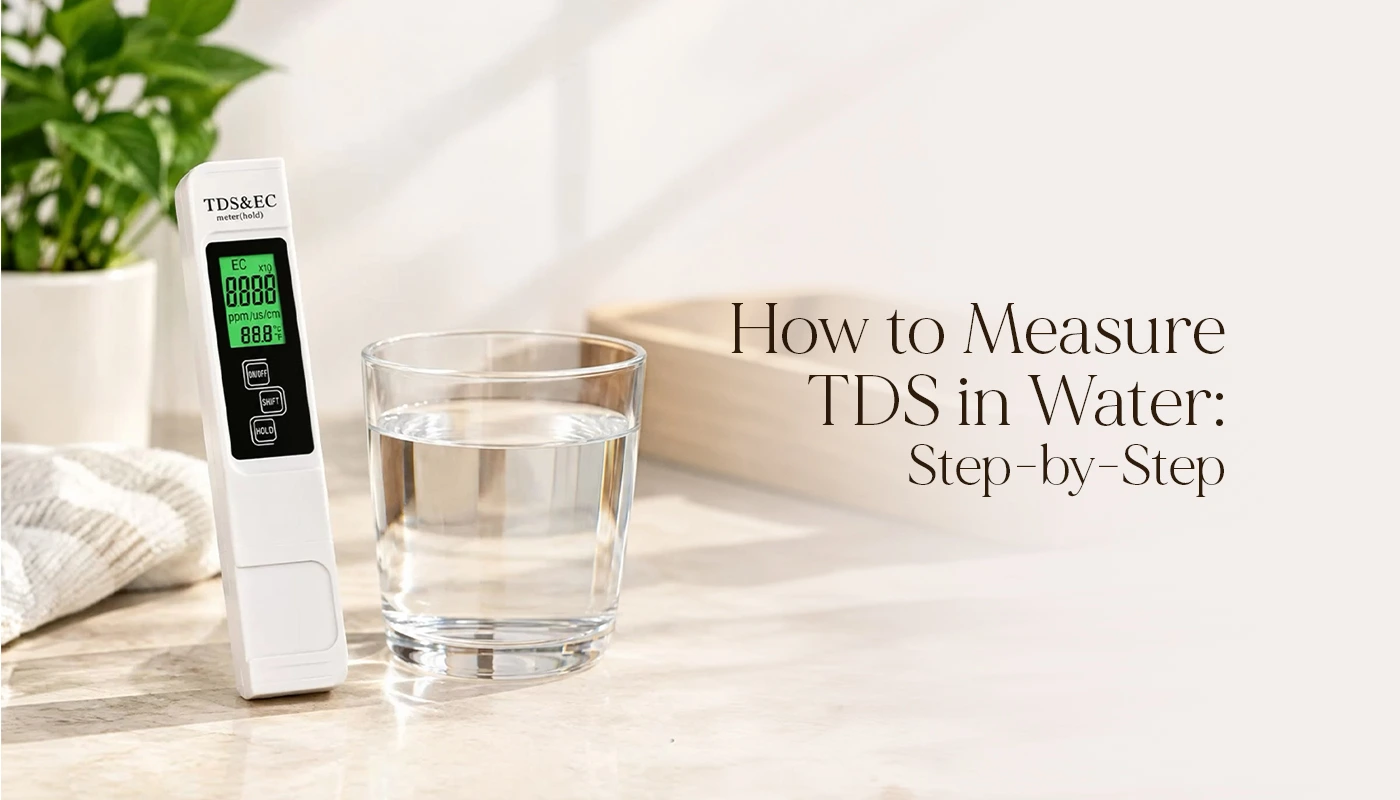
Take a clean glass or container and collect water directly from the tap you want to test.
If you are checking the water you normally drink, collecting a sample from the kitchen tap is generally more useful than testing water that has been sitting in a bottle for several hours.
You can also collect separate samples if you want to compare different sources.
For example:
Labeling each sample can make comparisons easier.
Switch on your digital TDS meter.
Depending on the model, the screen may display a starting value before the probe is immersed.
Make sure the meter is being used according to its manufacturer’s instructions.
Put the probe into the water sample.
Do not immerse the device beyond the manufacturer’s recommended level.
Once the probe is in the water, the display should begin showing a TDS reading.
The number may change slightly for a few seconds.
For example:
335 → 342 → 348 → 345 ppm
Once the number becomes relatively stable, record the approximate reading.
In this example, you could record the result as 345 ppm.
After testing, rinse the probe with clean water and dry or store it according to the manufacturer’s instructions.
This helps prevent residue from one water sample from affecting another reading.
Most household TDS meters display the result in ppm.
For example:
TDS: 450 ppm
This represents an estimated dissolved-solids concentration of approximately 450 mg/L.
It is important not to interpret this number as a direct measurement of every substance present in the water.
A TDS meter generally estimates TDS based on the water’s electrical conductivity. It cannot identify individual substances or determine whether bacteria or specific contaminants are present.
There is no single TDS number that can be used as a complete definition of safe drinking water.
The World Health Organization’s guidance discusses TDS primarily in relation to water acceptability and taste. It states that drinking water with TDS below approximately 600 mg/L is generally considered to have good palatability, while levels above approximately 1,000 mg/L can increasingly become unpalatable. WHO does not establish a health-based guideline value for TDS itself.
For example:
These examples should not be interpreted as a safety classification.
A reading of 250 ppm does not automatically prove that water is safe, just as a reading of 750 ppm does not automatically prove that it is unsafe.
The substances contributing to the TDS and other water-quality parameters also matter.
No. TDS alone cannot determine overall water quality.
This is one of the most important things to remember when learning how to check TDS of water at home.
Water quality can involve several different parameters, including:
For example, a TDS meter may show 300 ppm, but that number alone cannot tell you whether bacteria are present.
Similarly, a reading of 800 ppm tells you that the water contains a relatively high concentration of dissolved material, but it does not tell you exactly what those dissolved substances are.
If you have concerns about drinking-water safety, comprehensive laboratory testing may provide considerably more information than a TDS meter.
A high TDS reading indicates that the water contains a higher concentration of dissolved substances.
Suppose your household records these readings:
Date | Water Source | TDS |
1 September | Municipal | 245 ppm |
15 September | Municipal | 260 ppm |
20 September | Tanker | 690 ppm |
25 September | Tanker | 705 ppm |
The increase from approximately 260 ppm to 700 ppm coincides with a change in water source.
This does not prove that tanker water is unsafe. Instead, it tells you that the water’s dissolved-solids characteristics have changed.
Other reasons for a change in TDS can include:
If you notice a substantial or unexpected change, consider investigating the source and conducting additional water-quality testing where appropriate.
There is no dependable household method for obtaining an actual numerical TDS reading without measuring the water.
You may notice signs such as:
However, these observations cannot tell you whether your TDS is 200 ppm, 500 ppm or 900 ppm.
A digital TDS meter is therefore useful when you specifically want a numerical TDS reading.
For a broader assessment of water quality, however, laboratory testing is more comprehensive.
There is no universal testing frequency that applies to every household.
You may consider checking TDS when:
For example, if your regular tap water measures 230 ppm and your building changes its water source, checking the TDS again can help you understand whether the water characteristics have changed.
Understanding your incoming water can help you make a more informed decision when evaluating water purification options.
Consider two hypothetical homes:
Home A: TDS = 180 ppm
Home B: TDS = 780 ppm
The two homes may have substantially different water conditions.
However, TDS should not be the only factor used to select a purifier. The water source, hardness, other quality parameters and the manufacturer’s specifications for the particular purifier should also be considered.
For certain Coway India purifier installations, the company’s pre-installation assessment includes parameters such as TDS, turbidity, hardness, water flow and pressure. Coway’s current installation guidance specifies a TDS requirement of 400 ppm or less for that particular assessment. The exact requirements can vary by model and installation conditions.
This is why testing your water first can be a useful step before selecting a purification system.
You can keep your household monitoring routine simple.
For example:
Week 1: Test your kitchen tap water.
Week 4: Test it again.
When the water source changes: Test again.
If there is a major difference: Consider broader water-quality testing.
Keep a simple record of your readings.
For example:
Kitchen tap – 12 September: 260 ppm
Kitchen tap – 26 September: 275 ppm
A small difference may simply reflect normal variation.
But if your reading changes from 270 ppm to 850 ppm, it is worth finding out what changed in your water supply.
Learning how to check water TDS at home is relatively simple. A digital TDS meter can provide a quick estimate of dissolved-solids levels and can be particularly useful when you want to compare water sources or identify changes over time.
At the same time, it is important not to treat a TDS number as a complete water-quality report.
Your water may require consideration of other parameters depending on its source and circumstances. If you notice a significant change in TDS or have concerns about drinking-water quality, additional testing can help provide a clearer picture.
For households considering a water purifier, understanding the characteristics of the incoming water is a sensible starting point. The right purification approach should be based on the actual water conditions and the specifications of the purification system.
You can check TDS using a digital TDS meter. Collect a fresh water sample in a clean container, place the meter’s probe into the sample, wait for the reading to stabilise and record the displayed ppm value.
A TDS meter provides an estimate of the concentration of dissolved solids in water, generally based on electrical conductivity. It does not identify individual contaminants or provide a complete water-safety assessment.
WHO states that TDS below approximately 600 mg/L is generally associated with good palatability, while water above approximately 1,000 mg/L can become increasingly unpalatable. TDS itself does not have a health-based guideline value in current WHO guidance.
Not necessarily. A high TDS reading indicates more dissolved material, but TDS alone cannot determine whether water is safe. Other water-quality parameters and the specific substances contributing to the reading also matter.
There is no universal testing schedule for every household. Testing can be useful when your water source changes, you notice changes in taste or scaling, or you want to monitor household water characteristics periodically.
No. A TDS meter cannot detect or identify bacteria. Microbiological testing is required to assess microbial contamination.
No. Consider your water source and broader water-quality characteristics, including hardness, pH and microbiological quality where relevant. The purifier should also meet the manufacturer’s specified operating conditions for your water.